
Baking Soda and Vinegar on Carpet: Limits, Risks and Better Options
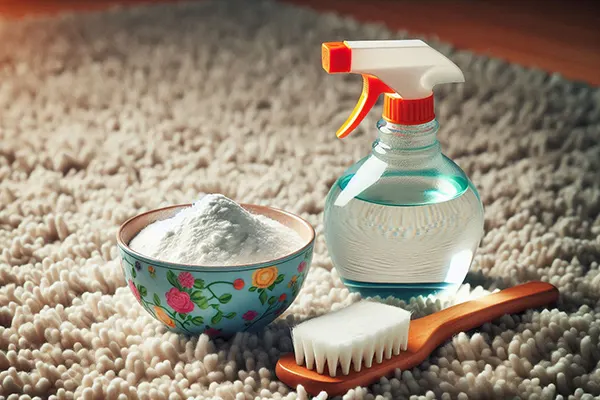
Baking soda and vinegar are not a universal carpet-cleaning system. They may change a smell or the appearance of a small mark, but that does not show that soil has been removed from the pile or backing. Before adding either, identify the carpet and the problem you are trying to solve.
- Do not soak a carpet or cover it in a wet powder paste.
- Use the carpet manufacturer’s instructions and an appropriate spot treatment.
- If a recipe has already been applied, tell the cleaner what, how much and when.
In this guide
- What the fizz does — and does not — tell you
- Match the response to the material and the problem
- A better first response to a spill
- If baking soda or vinegar has already been applied
What the fizz does — and does not — tell you
Vinegar’s acid reacts with bicarbonate and releases carbon dioxide. The American Chemical Society: the bicarbonate and vinegar reaction demonstrates the reaction. Bubbling is evidence of a chemical reaction; it is not a test of stain removal, disinfection or compatibility with a textile.
The result depends on the amounts and concentrations used. It is misleading to promise that every mixture becomes a powerful cleaner or that all mixtures become simply harmless water. Neither description tells you how dye, backing, adhesive or an earlier treatment will respond.
Match the response to the material and the problem
| Situation | More useful next step |
|---|---|
| A fresh liquid spill | Absorb it with a plain white cloth, then check the care instructions before treatment. |
| A dry surface residue | Check whether the vacuum is suitable for that material; keep liquid away until it has been assessed. |
| A persistent urine smell | Investigate how deeply the contamination travelled; perfume or repeated wetting is not a diagnosis. |
| A dull traffic lane | Assess embedded soil, wear and previous product residue rather than adding a stronger kitchen recipe. |
| Unknown fibre or water-sensitive rug | Get identification and care advice before adding water. |
WoolSafe: cleaning and maintenance of fine fibres highlights moisture-sensitive fine fibres and the importance of suitable products and restrained application. A recipe advertised for “synthetic carpet” also cannot be assumed safe for every backing or warranty.
A better first response to a spill
- Lift loose solids without grinding them in. Blot liquid with a plain white absorbent cloth; do not scrub.
- Find the carpet care instructions and identify the spill. Do not test a new chemical on the visible mark first.
- If a carpet-specific spotter is permitted, test it inconspicuously and let the test dry before judging colour and texture.
- Apply only as its label directs. Stop if the colour transfers, the mark spreads or the pile changes.
- Let the area dry and inspect it before deciding whether more work is justified.
The Carpet and Rug Institute: spots, spills and maintenance distinguishes absorbing a spill from treating the remaining spot. Our general carpet-care guide explains routine care and the limits of hand cleaning.
If baking soda or vinegar has already been applied
Stop layering products. Photograph the affected area and note the ingredients, approximate quantities and whether the carpet is still damp. Do not use a normal dry vacuum on wet powder or liquid; follow the machine’s restrictions for fine powders too.
For a damp paste, persistent smell, spreading ring or changed colour, request an assessment rather than trying to cancel one ingredient with another. Keep the area uncovered and arrange appropriate drying. Stain removal cannot restore dye that has already been lost.
Ask for a material-specific cleaning assessment
Share the carpet material, the original spill and every product already used. Crown can discuss an appropriate cleaning scope without promising that household-treatment damage can be reversed.
View the service and discuss the item before booking.
Sources and care guidance
Sources checked on 16 October 2026. Manufacturer guidance applies to the named products; use the instructions for your own item.